Why the Pulp Attitude Has Attracted Me
On Becoming a Fellow Traveler
Tuesday, September 26, 2017 10:09 am
You can be shaped by what you will not do. I will not drink. I will not curse. I will not lose my temper. Exclude the vices and you become other than vicious.
But “other than” is not enough. The bad is a privation of the good; but the good is not a privation of the bad. You must also be shaped by what you do. Include the virtues and you become virtuous.
We all know science fiction has become vicious. It is a platform for despising God, truth, men, women, and civilization. It gathers the mentally disordered and celebrates their diverse disorders. I just want to read about the defeat of killer robots and instead I must read about six-way sex on the planet Luvwyns.
But “other than” is not enough. The bad is a privation of the good; but the good is not a privation of the bad. You must also be shaped by what you do. Include the virtues and you become virtuous.
We all know science fiction has become vicious. It is a platform for despising God, truth, men, women, and civilization. It gathers the mentally disordered and celebrates their diverse disorders. I just want to read about the defeat of killer robots and instead I must read about six-way sex on the planet Luvwyns.
StoryHack #1 Is Out
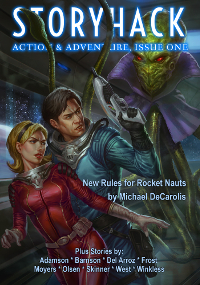
Anyhow, StoryHack #1 is out. Buy it on Amazon (to give the publisher money). Review it on Amazon (to increase its rank). Read my story Some Things Missing From Her Profile and be amazed by my superlativiosity. Go, now!
P.S. It's awesome to be in the inaugural issue. Yes, there was a proof-of-concept issue #0, but being in #1 feels nice.
Read My Story in It!
Tuesday, September 26, 2017 9:45 am
Anyhow, StoryHack #1 is out. Buy it on Amazon (to give the publisher money). Review it on Amazon (to increase its rank). Read my story Some Things Missing From Her Profile and be amazed by my superlativiosity. Go, now!
P.S. It's awesome to be in the inaugural issue. Yes, there was a proof-of-concept issue #0, but being in #1 feels nice.
The Rot Is Deep
It's All So Casual Now
Sunday, September 17, 2017 9:03 pm
So, on Netflix, I'm watching The Blacklist, that show starring James Spader. Generally it's just cool and outrageous. Like most modern TV, though, it can't merely deliver its clever plot but must also deliver an Approved Point of View.
It is particularly annoying when Reddington, an amoral killer, goes on some dogmatic rant about, oh, religious intolerance of sodomy. The writers, in their own real lives, hate (or at least must seem to hate) such intolerance, and so they can't help but depict their "hero" as doing the same — even if it makes him, at least briefly, a mouthpiece instead of a person.
Sadly, though, I experienced a more dispiriting moment in the show. Dogmatic rants at least indicate the writers are aware that they are taking positions. What happens when the rot is utterly unconscious?
It is particularly annoying when Reddington, an amoral killer, goes on some dogmatic rant about, oh, religious intolerance of sodomy. The writers, in their own real lives, hate (or at least must seem to hate) such intolerance, and so they can't help but depict their "hero" as doing the same — even if it makes him, at least briefly, a mouthpiece instead of a person.
Sadly, though, I experienced a more dispiriting moment in the show. Dogmatic rants at least indicate the writers are aware that they are taking positions. What happens when the rot is utterly unconscious?
That's Where You'll Find Me
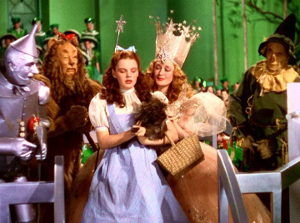 There's a misalignment in The Wizard of Oz.
What is its moral? "There's no place like home." Dorothy has found herself in a land over the rainbow, and yet her ultimate desire — the fulfillment of which she asks of the Wizard — is to return to Kansas. Near the end, Glinda prompts Dorothy to articulate the lesson that she, Dorothy, has learned; and Dorothy replies:
Maybe Dorothy Sings About the Wrong Thing
Saturday, August 12, 2017 12:19 pm
What is its moral? "There's no place like home." Dorothy has found herself in a land over the rainbow, and yet her ultimate desire — the fulfillment of which she asks of the Wizard — is to return to Kansas. Near the end, Glinda prompts Dorothy to articulate the lesson that she, Dorothy, has learned; and Dorothy replies:
If I ever go looking for my heart's desire, I won't look any futher than my own backyard. Because if it's not there I never lost it to begin with.This lesson, of course, accords with the narrative facts that the Scarecrow, the Tin Man, and the Cowardly Lion each already had the thing he sought. The Scarecrow was already brainy; the Tin Man, full of heart; the Lion, courageous. And Dorothy, in Kansas, already had the place most free of trouble: her home with Aunt Em and Uncle Henry.
Good News
I've Sold a Story
Sunday, July 16, 2017 2:23 pm
I've never had a writing career. For a time in the 1990s I had a contract with Simon & Schuster. I produced three books. I never properly capitalized on that part of my life, however. It all faded away. Then I resumed the author's life of rejection after rejection.
Today, though, I can report that I have sold a story. I took one of the stories that was rejected just this past month and submitted it to another magazine. This time it was accepted. I'll give you more details as things develop (not least the name of the fine magazine in question), but for now I'll only say that the story should see print before year's end.
Yes, I'm getting paid, too, a standard and proper rate.
Thanks, God.
Today, though, I can report that I have sold a story. I took one of the stories that was rejected just this past month and submitted it to another magazine. This time it was accepted. I'll give you more details as things develop (not least the name of the fine magazine in question), but for now I'll only say that the story should see print before year's end.
Yes, I'm getting paid, too, a standard and proper rate.
Thanks, God.
Wait. I Have a Blog?
The Days Do Pass
Thursday, July 6, 2017 10:37 am
So I spent May and a little of early June writing two stories for two magazines, each of which would be reading submissions in June. This blog, which has always been neglected, was thus especially neglected. My daily portion of words went into the fiction.
So I submitted the stories. Both were rejected.
One came close to acceptance and for that I'm grateful. Both magazines were outstanding in their responsiveness. They acknowledged receipt of my stories, kept me posted, and rejected me in a timely fashion. Now, that's not snark. I have spent my life waiting and waiting and waiting for magazines and publishers to get back with me. You put a work on hold while you wait. And it's months and months and months and finally you have to nag... But not this time. It was damn nice to be treated with courtesy.
While I was waiting I did some reading and vidya and a fair amount of real life. I hope to create a better balance and keep this blog alive, somehow. I actually have a couple of ideas for posts, one about the Wizard of Oz and one about Warhammer 40K.
See you in a bit.
So I submitted the stories. Both were rejected.
One came close to acceptance and for that I'm grateful. Both magazines were outstanding in their responsiveness. They acknowledged receipt of my stories, kept me posted, and rejected me in a timely fashion. Now, that's not snark. I have spent my life waiting and waiting and waiting for magazines and publishers to get back with me. You put a work on hold while you wait. And it's months and months and months and finally you have to nag... But not this time. It was damn nice to be treated with courtesy.
While I was waiting I did some reading and vidya and a fair amount of real life. I hope to create a better balance and keep this blog alive, somehow. I actually have a couple of ideas for posts, one about the Wizard of Oz and one about Warhammer 40K.
See you in a bit.
Concert After the Fish-Fry
Arvo Pärt's Passio
Sunday, April 9, 2017 10:48 am
I've been listening to Arvo Pärt for quite a while. I'm not sure how I discovered him. He is still alive and still composing. His work, since the 1980s, has been generally focused on the sacred, using chant and polyphony.
I don't know much about music. I know most definitions; I can follow a discussion well enough. But I cannot explain to you the difference between a harmony and a melody — not with understanding. And I cannot distinguish either in a work. I am stupid when it comes to music. Fundamentally I am sub-intellectual. For me, a musical work is either a good noise or it's disposable.
I don't know much about music. I know most definitions; I can follow a discussion well enough. But I cannot explain to you the difference between a harmony and a melody — not with understanding. And I cannot distinguish either in a work. I am stupid when it comes to music. Fundamentally I am sub-intellectual. For me, a musical work is either a good noise or it's disposable.
© 2004-26 David Skinner · All rights reserved