Spawn of Mars
Blog of Fictioneer David Skinner
Deckard Is Not a ReplicantNo Matter What Ridley Scott Thinks
Saturday, May 24, 2008 6:00 pm
Blade Runner is about memory and mortality: memory as the fountain of genuine life; mortality as the completion of memory.
A replicant begins full-grown, with not a birth date but an incept date. Rachel's memories of childhood are implants, not lived by her but merely received; her life is not genuine. Leon has his precious photographs — some secondhand, but others of his companions: assertions of Leon's own memory, fragments of a genuine life. Roy recalls the magnificent things that he himself has seen offworld, things never seen by Deckard, things that will be lost when Roy dies (by design) only a few years after his incept date.
Roy's mortality, like that of all replicants, is more a brutal termination than a proper completion. Humans acquire their memories slowly, naturally, almost leisurely. Their lives accumulate. Humans live; whereas replicants only briefly exist and must long for life. Even so, the plight of the replicant is of course a metaphor for our own plight.
Although the humans seem to have the better of things, the point of the film is that we do not. Our lives may be genuine, but they are no less ephemeral. Death, whether after four years or eighty, is still death. What, after all, is the final line of the film? As Gaff says of Rachel: "It's too bad she won't live; but then again, who does?"
Now, imagine how stupid the movie would be if Deckard were a replicant, too. The photos that adorn his piano — those old, sepia-toned photos, presumably of generations of his family — become as pathetic as Leon's. More pathetic, indeed meaningless, for at least Leon's are of his real friends. If Deckard is a replicant, we would have to conclude he is precisely as deluded as Rachel. He, too, is one of the latest models who don't even know they're replicants.
Which means that his entire history as a replicant-killer is false. Which means that all his world-weary despair is false. Which means that the heart of the film — the tension between the tragic replicants who cherish life (yet kill) and the degraded human who takes life for granted (while killing replicants) — is false. Which means that the end of the film — when Deckard chooses not to kill a replicant — ceases to be a moment of redemption for Deckard, and even in the "not-as-happy" director's cut becomes no more than the happy escape of two misbehaving robots.
Gaff's line means nothing if Deckard is a replicant. It should assert the equivalence, really, of replicant and human, at least as regards the brevity of earthly existence. The first part ("she") connects to Rachel, the second ("who") to Deckard. But if Deckard is just another Rachel, Gaff's line is emptied. Its second part becomes a mere aphorism, disconnected from any actual protagonist. If Deckard is a replicant, then he no longer carries the role of human in the film. The themes of memory and mortality become abstracted. Indeed, the themes are undermined, since suddenly what we thought was human actually is not. So what then is real?
What then is the point?
The movie becomes nonsensical if Deckard is a replicant! Either Deckard is as new as Rachel and everything about him is a lie, or he's been around for years, pretending to be human, some sort of stealth replicant deployed by Tyrell for — what? To prove what? You would have to deny everything Tyrell says and does, and go searching for grassy-knoll winks-and-nudges, to believe that Deckard is a deluded replicant. It doesn't matter what half-baked cleverisms Ridley Scott intended; it doesn't matter how many dopey unicorns clutter the film. If you believe that Deckard is a replicant, you are colluding in a cheap twist and have ruined the story.
I am not normally one to dismiss the intentions of the artist; but if we are meant to conclude that Deckard is a replicant, then Scott's intentions are bad, very bad. Say it with me: "Deckard is not a replicant." Nothing in the movie mandates that he is. Say he is not, and you will properly see Blade Runner for the wonder it is.
An Interruption of the WallpaperThe Emptiness of Rothko
Saturday, February 2, 2008 4:42 am
I am an optimist. I believe that foolish forms of art endure only so long as they are a means to self-elevation. Once it is no longer the Mark of the Smart Set to gush about a certain sort of art, that art will be abandoned.
Modern art is foolish art. Yet it has been tenacious; here we are, in 2008, and people still revere someone like Mark Rothko. But then, modern art is also the cry of the decadent, and decadence takes a while to play out. Perhaps only at the final passing of our civilization will the noisome banalities be properly held in contempt.
Till then, some of us can keep our senses and call modern art what it is: Art with a capital F.
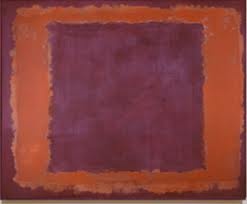
This is one of Rothko's paintings, untitled, from 1958, part of a larger, unfinished series of murals, intended for the Four Seasons restaurant in the Seagram's Building in New York City. It's like most of his "masterpieces": rectangles of color, arranged just so. Rothko's intentions — when considered with his actual work — are comical. He would speak about myth and intensity. "I'm interested only in expressing basic human emotions, tragedy, ecstasy, doom and so on." His paintings were, he said, the "opposite of restful." What with the recent Holocaust and the existence of the atom bomb, normal depiction of figures and landscapes was out of the question. We had to choose instead a "pure expression of feeling." And thus... behold!
I don't know how to mock this painting of rectangles. It mocks itself. When Rothko says, "The people who weep before my pictures are having the same religious experience I had when I painted them," I can only snort into my beer. If such as the above embodies a "religious experience," we can only imagine what sorts of explosive transcendence Rothko might have achieved had he used triangles or circles.
With his Seagram's murals, in particular, he wanted to inspire a sense of unending confinement, like being trapped in a passage. He wanted to "make those rich sons-of-bitches lose their appetites." Seagram's was paying him millions for the paintings, truly granting him a great compliment; and like all modern artists, he wanted only to discomfort and revile his benefactors. Using big brown rectangles.
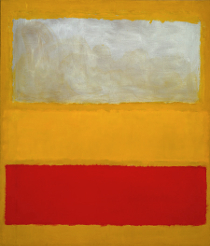
Rothko, after having dined himself at the Four Seasons, withdrew from the project. "Nobody who pays those kinds of prices for those kinds of meals is ever going to look at a painting of mine." Yet what he didn't realize is that his art is perfectly suited for the walls of a restaurant. His paintings are each an easily ignored decoration; an interruption of the wallpaper. They are the progenitors of what I call Corporate Wall Art — those formless, shallow arrangements of shapes and color that imply nothing, and adorn the reception areas and cafeterias of businesses everywhere. Because Rothko's paintings lack depth of information — strained imputations of myth and feeling notwithstanding — they can only end as corporate wall art; and only our ever-deluded intellectuals can claim greatness for such emptiness.
A Bourne RuminationOn the Last of the Trilogy
Sunday, January 13, 2008 3:52 pm
Beware! Spoilers follow.I can watch the first two
Bourne movies repeatedly and still enjoy them. They really do succeed. In general I am annoyed that they, like too much out of Hollywood, find the greatest criminality among
American spies; but hey, they
are exciting and they
aren't cartoons.
Having heard that The Bourne Ultimatum was even more anti-American, I wasn't so sure I wanted to bother with it; yet I had also heard it was very good, and so I got it.Yes, yes, one could argue that it's not anti-American as such but only anti-CIA; but, in the end, it is Americans who are the bad guys, so it's a bit sour. It also spins its wheels a bit, as far as the action goes; the variations on a theme were sometimes not so variant. Still, I really liked it — and unlike, say,
Spider-Man 3, it doesn't crater and ruin its trilogy, but finishes things very well.
Now, two observations.
First: The black-ops program of which Bourne is a part has the power to kill enemies of America without any red tape or real oversight. The movie is particularly outraged that even U.S. citizens have been terminated. Now, I am one who draws a distinction between citizen and non-citizen. It does make a difference whether the target of a black-ops assassination is a citizen or not. But I find it interesting that a Hollywood movie should try to raise our outrage by dealing in a distinction that, in most other contexts, it would sneer at. Asserting that we should especially not kill U.S. citizens is asserting that there is something special about U.S. citizens. A "citizen," in other words, is a real category, with real rights above the rights of non-citizens. How wonderfully true! Yet The Bourne Ultimatum is essentially championing nationalism, even — if you want to be crude — tribalism. Are we finally allowed, dear Hollywood, to favor our own people over others?
Second: The Bourne trilogy is, action aside, about Bourne's journey towards his origins as an assassin; more to the point, towards knowledge of his true identity. And here the movie does something that I so hope I am not misinterpreting.
In all three movies, we have been led to think that Bourne was programmed to be a killer, brainwashed simply; and the final movie emphasizes this idea, showing flashbacks of Bourne being broken down so that his old identity would be lost. Yet his true origin as an assassin comes in a single moment. He is calmly sitting in a room with the man in charge, who is essentially saying to him: "Now's the time; you can leave or stay;" and Bourne is hesitating, perhaps agonizing; and then Bourne stands up and shoots and kills a hooded prisoner, about whom Bourne knows nothing. That is when he becomes an assassin: When he chooses to kill.
In other words, he can't escape responsibility by saying he was brainwashed or tortured. He made the choice. It wasn't the evil CIA that corrupted him; it was he himself. Bourne misused his free will. And of course, in the present day, he chooses not to kill; notably he does not "take the shot" when he has another assassin in his sights. Bourne doesn't overcome the nasty CIA; he rejects the choice he made in the beginning, and restores himself. He has repented. Is it an accident that, in a movie indifferent to explicit religion, Bourne is identified (via his old dog tags) as Catholic? Is this a clue? Am I encouraged to give a Catholic interpretation to Bourne's original sin? Encouraged or not, I do; and it is a very satisfying resolution of the trilogy.
Depicting Christ AnewEncouragement From the Past
Sunday, May 27, 2007 1:54 am
How am I to say anything anew? For two thousand years, artists have been depicting Christ and what He was and is. Even if I am inclined — even if I am
impelled — to express, in my fiction, an image of Christ, what fresh manner can I take? I am not clever enough; and my civilization is in its decadence: it offers no help; it has spent itself. At the end of our culture, all has been done and done.
Or perhaps I am just not trying hard enough. You might think all has been done — and then you discover something. I discovered something. To be sure, this thing exists, is known, and, indeed, is more than three hundred years old and therefore rather far from fresh; but it has struck me nonetheless and made me hope, at least a little.
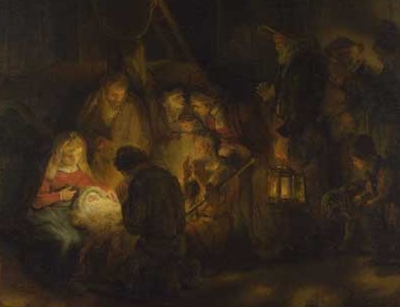
First, not the thing itself, but something else. Here is a detail from Rembrandt's 1646 Adoration of the Shepherds:Consider how conventional it is. I am not disparaging it. I like it. The lighting, and especially the kneeling man in the foreground, give a great sense of people around the Christ Child. But again, it is conventional: Child on display, lit by His own holiness, all but formally presented by His Mother.
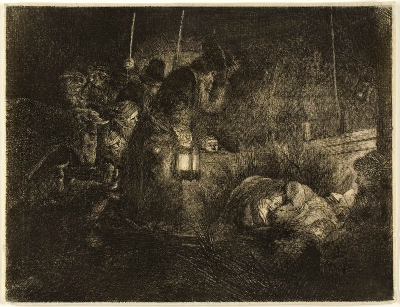
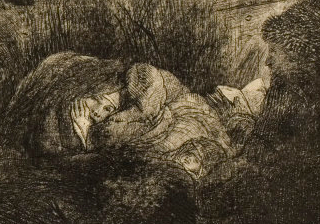
Now, here is the thing I discovered, also by Rembrandt, also an Adoration of the Shepherds, but an etching from ca. 1652:This doesn't have a spatial depth like the other work. You don't quite feel anyone moving towards and around the Christ Child. But there are other sorts of depth, and in this work the narrative depth is greater.Look closely at Mary and the baby. They are bundled and lying beside each other. Joseph, off to the right, is wearing a hat. It is cold. Of course, having just given birth, Mary is tired. The baby is tired. Mother and newborn are wrapped in the same thick blankets, trying to sleep, while Father, reading a book, keeps watch. And now they are being disturbed. Look: Mary has raised her hand against the shepherd's light! There is no formality; no presentation. Even the holy light of the Child is subtle: It's not His light but the light of a flame that Joseph is reading by.
What so struck me about this work is how well Rembrandt depicted the humility of the Incarnation. The shepherds may have come at the prodding of some angel, and they may be primed to adore the Savior of Mankind, but what they have found, at least initially, is only a cold and tired little family. The fact that Rembrandt swaddled Mary... That, I think, is the most wonderful touch.
So there it is. It's been a while since I saw a fresh depiction of the Nativity. Sure, maybe I don't get out enough, and sure, this depiction is 355 years old, and surely at least 355 other people have noticed the aspects I have noticed. Still, the wonder and pleasure are there. An artistic depiction of Christ has surprised me. Whenever I wonder, "How shall I depict Him anew," I will remind myself of Rembrandt's etching and try a little harder.
When Only Corruption Is AuthenticThe "True" Self, Revealed
Saturday, July 29, 2006 9:44 pm
There is a conceit that most of day-to-day life is a lie and, underneath it all, seething darkly, lives the truth. Thus, when a good man says or does something bad, we thereby learn what he is "really" like. But have we so learned? Bad acts or words are bad precisely because they present a failure; they signal a corruption. The man who, especially when drunk, does or says disreputable things has not lost his mask; he has succumbed to his corruption. When he is sober and does and says reputable things, he is not being a hypocrite nor a traitor to his "authentic" self; he is rising above the sins to which we are all subject. Our authentic selves are the uncorrupted, sinless selves, what we would have been had not the Fall occurred. No matter the terrible thoughts that beset a man, they do not represent him truly, unless he pertinaciously and characteristically indulges them. A man's character, after all, is what he wills of himself. When his will is crippled, especially by drink, his character has been set aside and he fails himself. It is a shame, really, that when someone is kind to us one moment and unkind the next, we think the kindness was false and the unkindness true. It is uncharitable, really, to allow a bad act to trump a good. Yes, a single bad act, absent repentance, can be decisive; but only absent repentance. Isn't that what God has told us, after all?
A Bee Contemplates BuzzingThe Definition of High Art
Sunday, January 8, 2006 8:46 pm
Despite having been a writer for decades now and having had the unsurprising and frequent inclination, as a producer of art, to contemplate the nature of art, it was many years until I realized something that I think is very true.
Let me begin by stating the obvious: All works are not substantially equal. However much the academics might want to de-privilege the canon, there remains a qualitative difference between high art and low art. This, to be sure, is not news. If you think I am merely about to scoff at academics who overpraise hip-hop or graffiti, you would be wrong. Such academics, however much they perdure, have been adequately ridiculed already. My question is only this: Given the obvious fact that some art is high and some low, what is it, in the end, that distinguishes high from low? And my answer is this:
Depth of information.
This is not entirely my idea. I heard a man use "information content" to explain, in passing, why concert music is higher than popular music. But I believe "information content" — or, as I prefer to put it, "depth of information" — applies to all art and is, indeed, sufficient to distinguish high from low. Notice I am not saying "distinguish good from bad." "Good" is an aesthetic judgment, valid enough but not enough to make a work high. And "bad" does not mean a work is not high. "Information" applies, obviously, to content, but perhaps not as obviously to form. That is, a work of high art is presented in a form that itself invites contemplation and rational elucidation. A work of high art is elaborate in content and form. Its information is deep.
That may seem to be a truism, but what I am trying to get across is that "deeply informed" is the complete definition of high art. Yes, of course, we would argue about what constitutes "deep." But by defining high art as "deeply informed" we don't become sunk in questions of aesthetics or culture — or origins. Thus even masters can produce low art — art that is well-made, enjoyable, memorable; yet for all that, lacking depth and therefore not high. Just because it's Mozart doesn't mean it's higher than Metallica.
And, as an added bonus, my succinct definition finally makes it clear to me why so much art that is supposedly high has always struck me as anything but. With my definition in hand, one can finally banish the freeloaders from the house of high art. For example, like him or not, value him or not, Pollock is not high art, because there is nothing elaborate or deeply informed about his work. Nothing intrinsic, that is. You can read all you want into Pollock's paint spills; they're still just spills. Deep information cannot be imputed to the work but must subsist in the work for the work to be truly high.
Eternity With Love HandlesGod's Gonna Resurrect This?
Monday, August 1, 2005 1:54 am
It's right there in the Nicene Creed: "I expect the resurrection of the dead." On the final day we will each arise as Christ arose and be restored to our bodies, no matter how dispersed our flesh might be among the elements of the Earth. To be sure, on that day our bodies will be uncorrupted and imperishable, glorious bodies like the glorious body of Christ; but I've always wondered: What will those bodies
look like?
Christ looked like the Jesus at 33 — that is, the Jesus at the time of His death. If I died right now, would I be resurrected with a bald spot and love handles? Insofar as these things are a function of corruption, I suppose the answer would be no; but what, then, does that mean? Do I suddenly become the trim and virile, fit and vigorous man I am not? Do I become what I would have been, had I been born in Eden? I am sure that some theologians have pondered this; but I haven't read them. I don't think the Magisterium has an opinion, since the particular details of the general resurrection have not been given to the Church.
So if you don't mind, I will offer a little speculation.
An important clue, I think, is in the Eucharist. The glorious Body of Christ is there as the host; yet there are — obviously — no bodily attributes whatsoever. In other words, a resurrected and glorious body need not manifest itself in an expected way. The body is as real, distinct, and unique to each of us as are the reason, soul, and will. On the last day we will be given, again and truly, the bodies we had at death. But the notion that Heaven will be filled with infants, children, teenagers, and adults young and old seems absurd, somehow.
What will be returned to us, I think, is the substance of our bodies. In body we will be substantially as we were, just as a consecrated host is substantially the Body of Christ. Which is not to say we will be formless. We will surely have some form. Some default form, if you will. Yes, Christ can appear as 33-year-old man, just as Mary can appear as a very young woman, despite having raised a 33-year-old and lived long past his death; but what if they, and eventually we, default to something else? Say, to children? I'm not just being sentimental. I'm not getting all Hallmark on you. I'm serious. I suspect that in Heaven we will be children.
This hardly proves anything, but I'm especially guided by the following:And Jesus, calling unto him a little child, set him in the midst of them. And said: Amen I say to you, unless you be converted, and become as little children, you shall not enter into the kingdom of heaven. Matt. 18:2-3
And they brought to him young children, that he might touch them. And the disciples rebuked them that brought them. Whom when Jesus saw, he was much displeased and saith to them: Suffer the little children to come unto me and forbid them not: for of such is the kingdom of God. Amen I say to you, whosoever shall not receive the kingdom of God as a little child shall not enter into it. Mark 10:13-15
I know that Jesus was not being literal in these passages. His point, quite different from mine, was that we must be like little children if we expect to enter the Kingdom of God. Still, I find these words highly suggestive. It seems so right that Heaven would be filled not merely with childlike people but with actual children. Of such is the kingdom of God. And then there's this:For in the resurrection they shall neither marry nor be married, but shall be as the angels of God in heaven. Matt. 22:30
It's not so surprising that there would be no marriage in Heaven. After all, what is marriage for? Apart from providing for the best upbringing of children, marriage contains and sanctifies the act that produces those children. Since no more people will be created — let alone born and raised — after the end of the world, marriage will have no purpose. Sex will have no purpose. There will be no sex in Heaven. Unless you're an angry jihadi, I think you'd agree.
Well, what sort of human is it, who has no need or capacity for sex? A child, of course. Yes indeed, I am only speculating, and perhaps ill-informedly; but I really think that on the last day we will be resurrected as children.